

Rest Between Sets Matters: How Long Should You Really Rest?
When most people plan a workout, they focus on the exercises, weight, sets, and repetitions.
The time between those sets often receives much less attention.
You finish a set, check your phone, take a drink, talk with a training partner, or begin the next set whenever you feel ready. Sometimes that works. Other times, beginning too soon changes the training effect you were trying to create.
Rest is not time away from the workout. Rest is part of the workout prescription.
The appropriate amount of rest depends on what you are trying to improve. Training for explosive power does not require the same recovery as training for muscular endurance. A balance exercise should not necessarily be approached the same way as a conditioning circuit.
That is why there is no single rest period that is right for every exercise or every person.
What Happens During Your Rest Period?
Every challenging set produces some level of fatigue.
Your muscles use energy, force production begins to decline, and your ability to move quickly or maintain coordination may change. The rest period gives your body time to recover enough to perform the next set with the desired level of force, speed, and control.
Longer rest periods generally help preserve performance during exercises that require high force or power. In one study, five minutes of rest allowed participants to produce more force and complete more total work than two minutes during high-intensity resistance exercise. Research on plyometric training has similarly found that providing adequate recovery helps athletes maintain power across repeated sets.
Shorter rest periods are not necessarily wrong. They simply create a different challenge. Limited recovery increases fatigue and can be useful when the goal is muscular endurance, conditioning, or the ability to repeat efforts while tired.
The important question is not:
“How quickly can I start the next set?”
It is:
“What am I trying to accomplish with the next set?”
There Is No Perfect Rest Period
The American College of Sports Medicine’s updated 2026 resistance-training guidance emphasizes that exercise programs should be individualized rather than built around rigid, one-size-fits-all rules. Training variables should reflect the person’s goals, experience, safety, and ability to follow the program consistently.
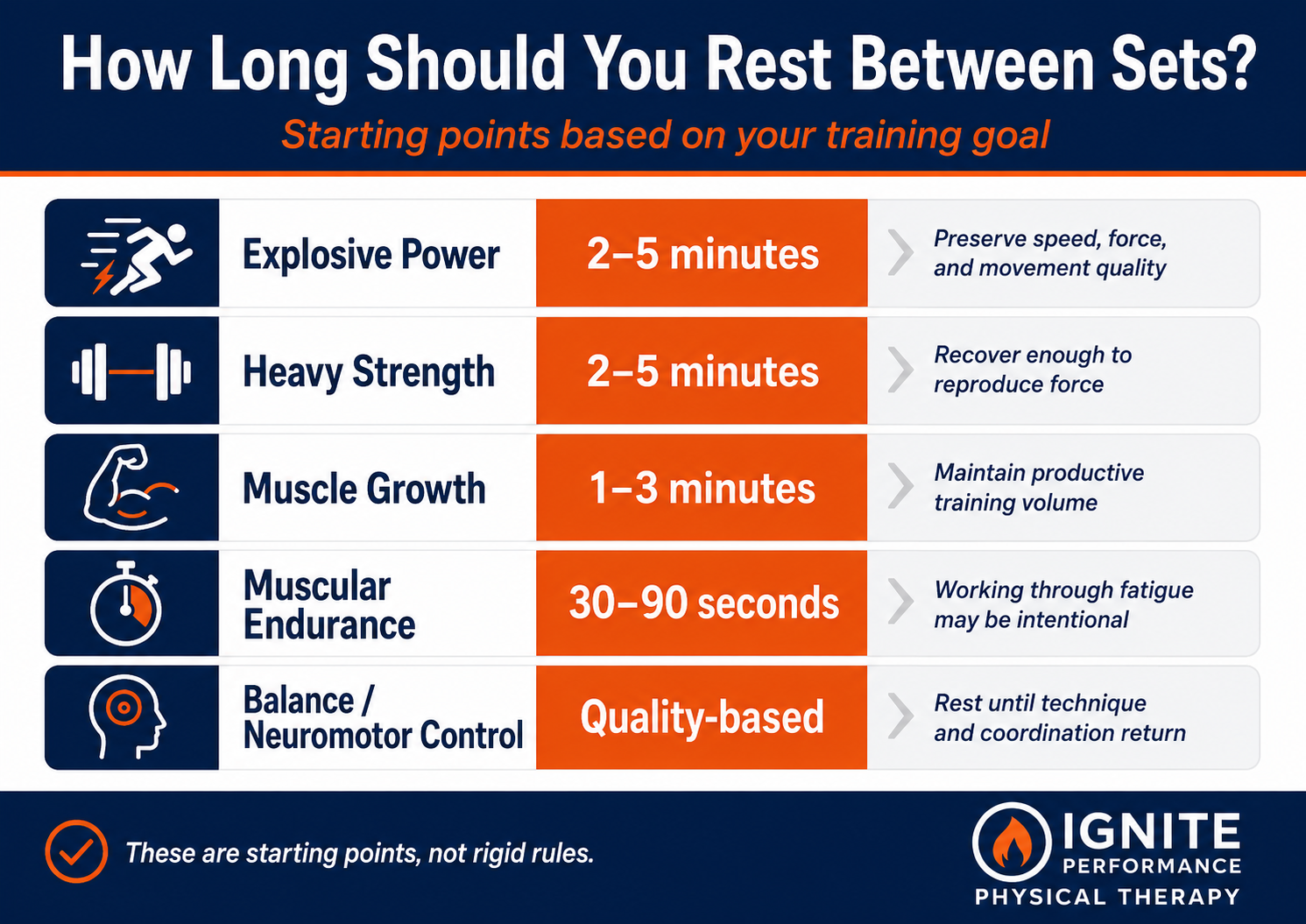
The following ranges are useful starting points:
Training goalStarting rest periodExplosive power2–5 minutesHeavy strength2–5 minutesMuscle growth1–3 minutesMuscular endurance30–90 secondsBalance and neuromotor controlRest until movement quality is restored
These ranges should guide the decision, not replace it. The exercise, load, number of repetitions, training experience, fitness level, and quality of the next set all matter.
Training for Power: Protect Speed and Explosiveness
Power training includes movements such as jumps, medicine-ball throws, Olympic-lift variations, explosive push-ups, and lighter resistance exercises performed with maximal intent.
The purpose is to produce force quickly.
If an athlete performs a great set of jumps, rests for only 20 seconds, and then begins jumping lower, landing louder, or moving more slowly, the second set may no longer be training the same quality.
It may still be difficult, but difficulty and effectiveness are not always the same thing.
Research on repeated plyometric exercise found that longer recovery helped participants maintain power across sets better than continuous work or shorter recovery. Studies of cluster training—where brief rests are inserted within a set—have also shown that distributing rest can help maintain force, velocity, and power while reducing fatigue.
For power training, rest long enough that the next set can still be performed explosively.
For many people, that means approximately two to five minutes, depending on the exercise and intensity.
Training for Strength: Give Yourself Time to Produce Force
Heavy strength exercises place a significant demand on the muscular and nervous systems.
When performing heavy squats, deadlifts, presses, or similar compound exercises, starting the next set too soon may reduce how much force you can produce. It can also cause technique to change as fatigue builds.
That is why heavy strength work generally benefits from longer recovery periods.
For challenging compound lifts, a starting range of two to five minutes is often appropriate. The heavier the load and the more technically demanding the exercise, the more likely you are to benefit from the longer end of that range. Research has found that longer rest can preserve neuromuscular output and allow more productive work to be completed during a session.
You do not receive extra credit for turning every strength session into conditioning.
Sometimes the best way to train harder is to rest long enough to perform the next set well.
Training for Muscle Growth: Maintain Productive Volume
Muscle-building workouts are often associated with short rest periods and a significant “burn.”
That feeling can be part of the workout, but it should not be the only goal.
Resting too little may cause your repetitions or resistance to drop so quickly that you complete less productive work. A 2024 systematic review found that muscle growth can occur across a wide range of rest periods, but resting longer than 60 seconds may provide a small advantage compared with very short recovery periods. The researchers did not identify a clear additional benefit once rest exceeded approximately 90 seconds, although individual exercises and training demands still matter.
For most muscle-building exercises, one to three minutes is a reasonable starting point.
You may need closer to two or three minutes for demanding compound exercises such as squats, presses, and rows. Smaller accessory exercises may require less.
The goal is to recover enough to maintain good technique and accumulate meaningful training volume.
Training for Muscular Endurance: Fatigue May Be Part of the Goal
Muscular endurance refers to the ability to produce repeated contractions or maintain an effort over time.
In this setting, incomplete recovery may be intentional.
Higher-repetition resistance exercises, circuits, carries, sled work, and other conditioning activities may use rest periods of approximately 30 to 90 seconds. Older ACSM guidance has similarly recommended short recovery periods of less than 90 seconds for local muscular-endurance training.
The shorter rest creates a different adaptation than heavy strength or power training.
However, shorter does not automatically mean better. If fatigue causes the exercise to become unsafe or changes the movement beyond recognition, the rest period is no longer supporting the intended goal.
Balance, Coordination, and Rehabilitation: Quality Comes First
Balance and neuromotor exercises are designed to improve coordination, control, body awareness, and the ability to organize movement.
These exercises are commonly used in sports performance, injury-prevention programs, and rehabilitation.
The goal is usually not to become as tired as possible.
A randomized controlled trial found that people who performed balance training while already fatigued experienced smaller improvements than those who trained in a less-fatigued state. The researchers concluded that balance work may be more effective when performed earlier in a session or while the individual is relatively fresh.
For balance, landing, cutting, and movement-control exercises, the clock is less important than the quality of the movement.
Before beginning the next repetition or set, ask:
Can I control the position?
Can I maintain my balance?
Can I land quietly and confidently?
Can I perform the movement without compensating?
Does this repetition look like the movement that was prescribed?
If the answer is no, take more time or reduce the difficulty.
How Do You Know When You Are Ready for the Next Set?
You can time your rest, but the timer should be a starting point rather than the only deciding factor.
Pay attention to what happens when you begin the next set.
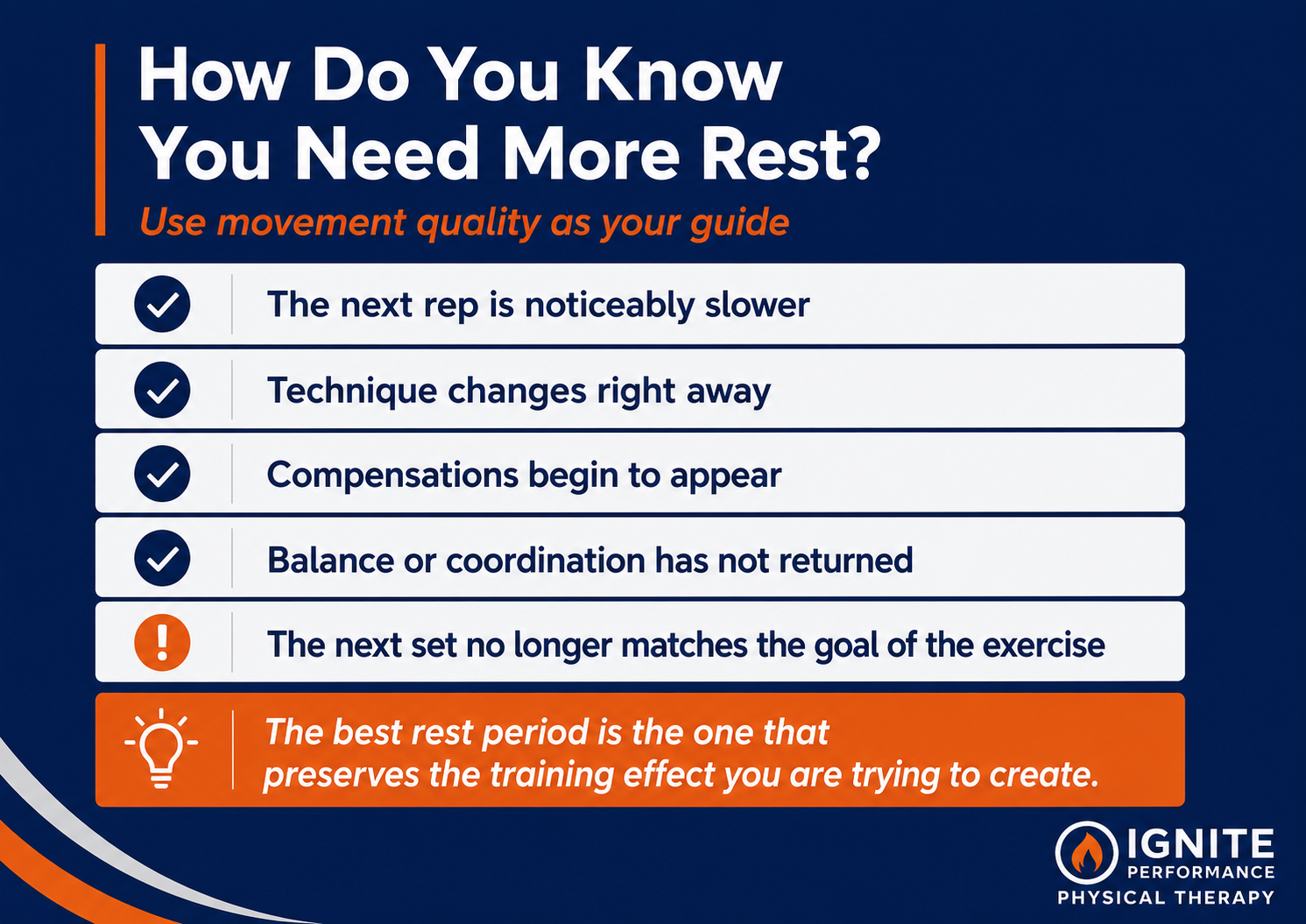
You may need more recovery when:
The first repetition is noticeably slower than the previous set.
Your technique changes immediately.
You cannot maintain the prescribed load or repetition range.
Your balance or coordination has not returned.
A jump, throw, or explosive movement has lost height, distance, or speed.
You are creating compensations simply to finish the exercise.
Technology can provide additional information. Velocity trackers, force plates, and other performance tools can help measure changes in speed, force, and power. But technology does not replace observation or coaching. It gives us another way to determine whether the athlete is producing the intended training effect.
Without technology, movement quality remains one of your best guides.
Rest With Intention
Consider two athletes performing the same exercise.
One is completing heavy squats to improve maximal strength. The other is using lighter squats as part of a conditioning circuit.
The exercise may look similar, but the desired adaptation is different. Their rest periods should probably be different as well.
The same principle applies to active adults returning from injury. A single-leg exercise used to restore balance and control should not automatically be rushed because someone believes they need to “feel the burn.”
Before beginning a set, know what you are trying to develop. Then use your rest period to support that goal.
Practical starting points
For power and heavy strength:
Rest approximately two to five minutes and prioritize force, speed, and technique.
For muscle growth:
Begin with one to three minutes and make sure you can maintain productive repetitions and good form.
For muscular endurance:
Use approximately 30 to 90 seconds when incomplete recovery is intentionally part of the training stimulus.
For balance, coordination, and movement control:
Rest until you can repeat the movement with the quality that was prescribed.
The Bottom Line
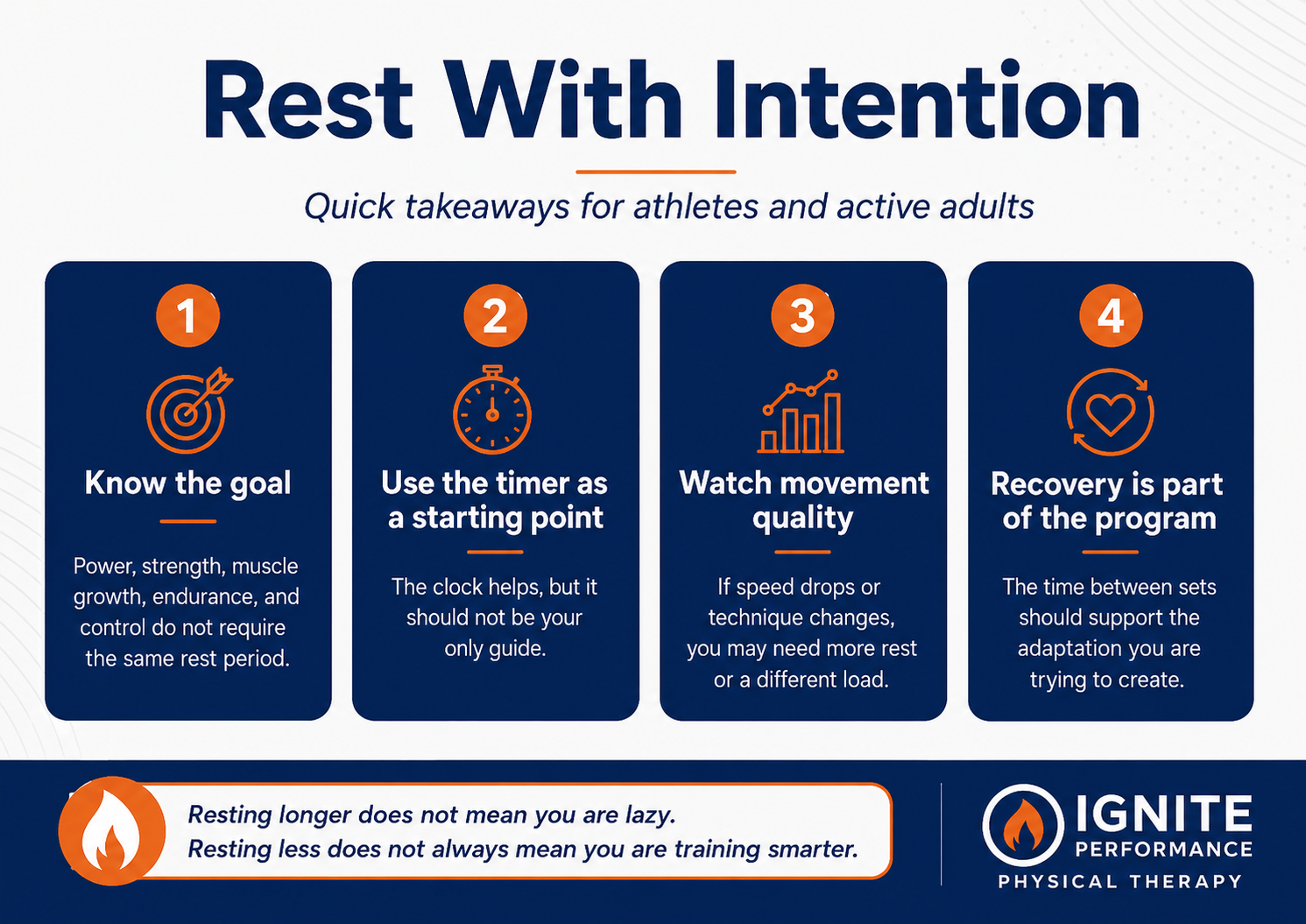
Resting longer does not mean you are lazy.
Resting less does not always mean you are working harder.
The right amount of rest is the amount that helps create the adaptation you are actually training for.
At Ignite Performance Physical Therapy, we consider more than the exercise itself. We look at the goal, the athlete, the movement quality, the training load, and the recovery required to produce the desired result.
Whether you are returning from an injury, preparing for your season, or trying to continue training without pain, every part of the program should have a purpose—including the time between sets.
Recovery is part of the program.
Ignite Your Recovery. Elevate Your Performance.